


A Coder’s Queue That Never Gets Shorter
Picture a hospital billing department on a Tuesday morning: three coders are out sick, the charge queue has backed up past four hundred encounters, and a cardiology group is asking why last month’s claims still haven’t gone out. This is not a rare scene. It plays out weekly in hospitalist groups, inpatient specialty practices, and rounding teams across the country, where documentation volume keeps climbing faster than staffing budgets can keep pace.
The root issue is not laziness or poor management. Inpatient coding is simply harder than outpatient coding in almost every respect. Admissions, transfers, consults, and discharges generate layered documentation from multiple providers, often written in different formats and styles, and someone has to translate all of that into accurate codes before a claim can move. When that translation slows down, cash flow slows down with it, and administrators end up treating billing delays as a permanent cost of doing business rather than a solvable problem.
Teaching Machines to Read Clinical Notes Like Coders Do
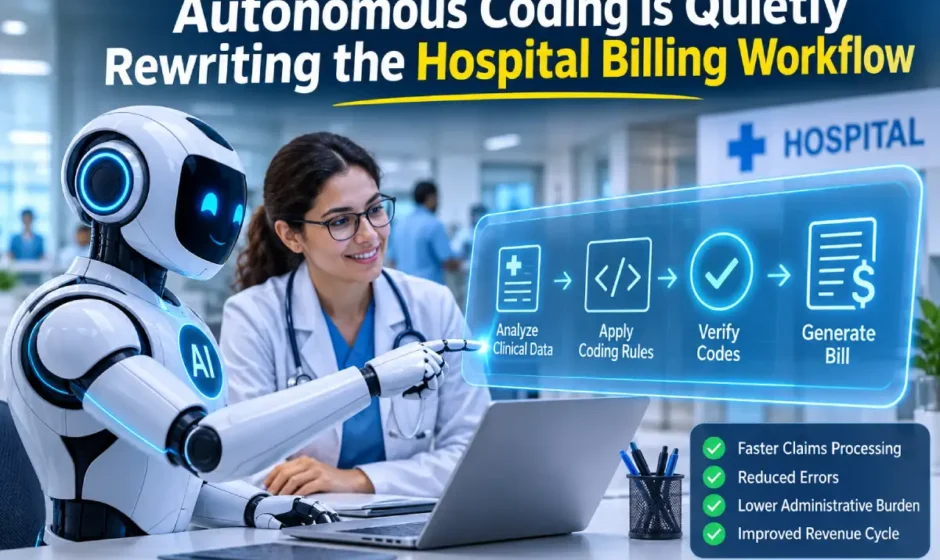
Autonomous coding tools attempt to close that gap by applying natural language processing directly to clinical documentation, pulling diagnosis and procedure codes without a human coder touching every chart first. Instead of a coder manually scanning a progress note to decide which codes apply, the software reads the note, cross-references clinical indicators, and proposes or finalizes codes based on patterns learned from enormous volumes of prior claims. For routine, well-documented encounters, this can happen in seconds rather than the hours a backlog might otherwise require.
The technology has matured quickly, but it has not replaced judgment entirely, and that shift in responsibility shapes how it gets used in practice. Straightforward encounters with clear documentation are often coded with little or no human review, while complex cases, ones involving multiple comorbidities or ambiguous clinical language, still get flagged for a certified coder to examine. That triage function is arguably more valuable than the raw automation itself, because it lets experienced coders spend their time on the charts that actually need expert interpretation instead of the ones that don’t.
Accuracy depends heavily on how well these systems have been trained against current coding guidelines, particularly around visit complexity and medical decision-making. Hospitals adopting this technology need assurance that the underlying logic reflects the most recent guidance rather than a frozen snapshot from several years earlier, since payer scrutiny only increases when coding patterns look inconsistent with published standards.
Matching the Technology to Inpatient Billing Realities
Inpatient billing carries its own quirks that outpatient-focused coding tools sometimes handle poorly, including multi-provider documentation, evolving diagnoses across a hospital stay, and coordination between hospitalists and consulting specialists. A tool built primarily for clinic visits may struggle when a patient’s chart includes notes from four different physicians written across six days. Before adopting any autonomous coding platform, inpatient groups should ask pointed questions about how the system handles exactly these scenarios, because generic claims of accuracy rarely hold up against the messiness of a real hospital stay. Groups evaluating billing software for this purpose often find it useful to review top billing features for inpatient doctors, since inpatient-specific functionality tends to separate tools that genuinely fit hospital medicine from those adapted loosely from outpatient systems.
Implementation also matters as much as the underlying algorithm, and the rules governing evaluation and management coding rules offer a useful benchmark for judging whether a vendor’s logic has actually kept current. A platform that integrates cleanly with existing EHR workflows will get used consistently; one that requires coders to jump between systems will quietly get abandoned, no matter how accurate its code suggestions are. Groups should also examine how the vendor handles edge cases and claim denials, since a tool that can’t explain its own reasoning creates a different kind of bottleneck when payers push back. Audit trails and explainability features are not optional extras here, they are what allow a billing team to trust and verify what the software has decided.
Cost structure deserves equal scrutiny, since some vendors price per claim while others charge flat licensing fees regardless of volume, and the better fit depends entirely on a practice’s patient mix and seasonal variation. A group with heavy winter admission surges, for instance, may find per-claim pricing far more favorable than a flat annual contract. Reference checks with similarly sized inpatient groups can reveal more about real-world performance than any vendor demo, since those conversations tend to surface the integration headaches and denial patterns that sales materials rarely mention. None of this replaces the need for skilled coders on staff; it simply changes what those coders spend their time doing, shifting them toward exception handling, denial management, and the clinical judgment calls that still require a trained human eye.
Also Read: Decathlon Kota IN Indraprastha Industrial Area, Kota