

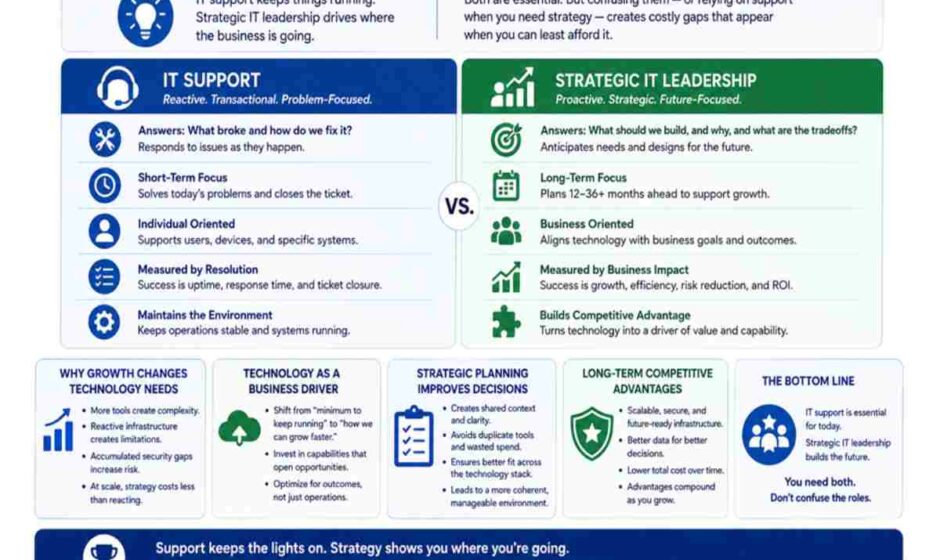

When a printer breaks, you call IT support. When you’re trying to figure out whether your technology infrastructure can support a 40% headcount increase over the next eighteen months, that’s a different conversation with a different kind of person.
Both conversations are valuable. Neither replaces the other. But confusing them — treating strategic IT questions as support questions, or assuming that a strong support function will naturally evolve into strategic leadership — creates gaps that tend to show up at the worst possible moments.
Understanding the distinction is one of the more practical things a growing business can do.
Traditional IT Support vs Strategic IT
IT support is transactional by design. A user has a problem. A technician resolves it. The interaction closes. Done correctly, this function is invisible — things just work, and nobody thinks much about it.
Strategic IT operates on a completely different timescale and with a different orientation. It’s not reactive, it’s anticipatory. It’s not solving the problem in front of you, it’s trying to prevent the problem from existing in the first place — or, better, ensuring that the technology environment is built in a way that turns capabilities into competitive advantages rather than operational constraints.
A support function answers the question: what broke and how do we fix it? Strategic IT answers the question: what should we build, and why, and what are the tradeoffs?
The skills overlap somewhat. Technical knowledge is useful in both. But the mindset, the planning horizon, and the stakeholder relationships are fundamentally different.
Why Growth Changes Technology Needs
In the early stages of a business, IT is mostly about keeping things running. You adopt software tools as you need them, manage them as best you can, and call for help when something breaks. This is appropriate. Early-stage businesses don’t need a CTO — they need someone who can get email working and set up the CRM.
As the business grows, this approach starts showing its costs. The tools acquired one at a time create integration complexity. The infrastructure scaled reactively doesn’t quite fit the architecture you’d design deliberately. The security posture built by accumulation rather than design has gaps that were never visible when the organization was small.
Growth doesn’t just mean more of everything. It means complexity that requires a different kind of thinking to manage well. And at some point, the cost of not thinking strategically about technology becomes higher than the cost of doing it.
Organizations investing in it strategy consulting gain stronger alignment between business goals and technology planning — which is another way of saying they stop making expensive decisions in the dark.
Technology as a Business Driver
The distinction that matters most for understanding strategic IT is this: IT support treats technology as an operational requirement. Strategic IT treats technology as a business driver.
These aren’t the same thing. An operational requirement is something you maintain. A business driver is something you invest in, optimize, and measure against business outcomes.
Think about what it means to approach cloud infrastructure as a business driver rather than an operational requirement. Instead of asking “what’s the minimum we need to keep things running?” you’re asking “what cloud capabilities would allow us to move faster, serve customers better, or open market opportunities that we currently can’t access?” The answers to those questions lead to different investments, different architecture decisions, and different returns.
This is the territory that strategic IT leadership operates in. And it’s territory that most support functions, however technically competent, aren’t designed to cover.
Strategic Planning Improves Decision-Making
One of the underappreciated benefits of strategic IT leadership is the improvement in how technology decisions get made across the whole organization.
Without strategic oversight, technology decisions tend to be made locally and reactively. A department head decides to adopt a new platform without fully understanding the integration implications. A procurement process approves a software subscription without considering whether a competing tool already in the organization does the same thing. Infrastructure investments happen without a clear picture of the full technology environment they’re being added to.
Strategic IT creates shared context. When there’s a technology roadmap — even a rough one — decisions get made against a common frame of reference. The department head knows what’s already in the stack and what’s planned. The procurement conversation happens with full information about what the business is building toward. Infrastructure investments are evaluated for fit, not just capability.
The result isn’t just better individual decisions. It’s a more coherent technology environment overall, one that’s easier to manage, cheaper to maintain, and more capable of supporting growth.
Long-Term Competitive Advantages
Businesses that build strategic IT functions early don’t just avoid problems. They compound advantages over time.
The technology infrastructure built with a three-year horizon in mind is easier to scale than one built reactively. The security posture designed with current threat models is harder to breach than one assembled from individual point solutions. The data environment designed to support decision-making actually supports decision-making, rather than requiring extensive manual work to extract insight from.
These advantages are genuinely compounding. A well-designed technology environment gets relatively easier to manage as it grows, because the architecture is coherent. A poorly designed one gets harder, because complexity accumulates and creates interdependencies that nobody fully understands.
The gap between these two trajectories isn’t immediately obvious at small scale. It becomes very obvious at larger scale — which is exactly when the business least wants to be dealing with it.
The goal isn’t to choose between IT support and strategic IT leadership. You need both. A great strategic plan doesn’t help you when the server is down. Reliable support doesn’t help you when you’ve built an infrastructure that can’t support your next phase of growth.
The question is whether your organization has both — and whether they’re working together. For businesses at a certain scale, the answer to that question matters more than almost any other technology decision.
Also Read: How Safe Driving Habits Influence Your Car Insurance Premiums