
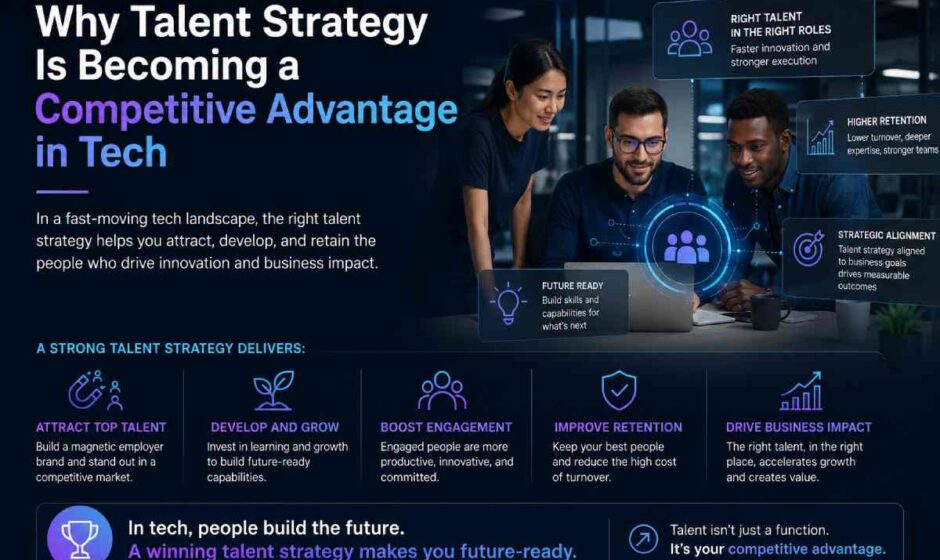

Tech companies used to win by having better products, faster engineering teams, or more funding than the competition. Those things still matter. But as artificial intelligence, automation, cloud platforms, cybersecurity needs, and data-driven decision-making reshape how companies operate, another advantage has moved to the front: talent strategy.
Who can attract the right people? Who can keep them? Who can train employees fast enough as roles change? Who knows which skills they’ll need two or three years from now instead of hiring reactively when the gap is already hurting delivery?
For tech executives, HR leaders, and hiring managers, these questions are no longer side issues. They’re business questions. A company’s ability to recruit, retain, and develop talent now affects product speed, customer experience, innovation, security, and profitability.
The challenge is clear. The World Economic Forum’s Future of Jobs Report 2025 surveyed more than 1,000 employers representing over 14 million workers across 55 economies and found that employers expect 22% of jobs to be disrupted by 2030. The same report estimates 170 million new roles will be created, while 92 million will be displaced, creating a net gain of 78 million jobs. That doesn’t mean companies can sit back and wait. It means the race for skills is getting sharper.
In tech, the winners won’t simply be the companies that hire the most people. They’ll be the companies that build the strongest systems for finding, growing, and keeping the right people.
The Tech Talent Problem Isn’t Going Away
The tech labor market can feel confusing. One month, headlines focus on layoffs. The next, companies are struggling to fill AI, cybersecurity, data engineering, cloud, and software roles. Both can be true at the same time.
Layoffs don’t automatically solve skills shortages. A company may reduce roles in one area while still needing machine learning engineers, product security specialists, data architects, or cloud infrastructure experts. Skills don’t always transfer neatly from one role to another.
McKinsey’s 2025 analysis of the tech talent gap estimates that the European Union could face a shortage of 1.4 million to 3.9 million tech workers by 2027. The same research notes that demand for technology talent may be two to four times greater than supply in the coming years. It also found no evidence that recent tech-sector layoffs have fully closed the gap between demand and available skills.
That’s a major warning sign for leaders. If talent supply remains tight, hiring alone won’t be enough. Companies will need a broader approach that includes workforce planning, training, internal mobility, retention, and employer branding.
A reactive hiring process creates delays. Teams wait months for hard-to-find candidates. Product roadmaps slip. Managers stretch existing employees too far. Burnout rises. Competitors move faster.
A strong talent strategy helps prevent that spiral.
AI Is Changing the Skills Companies Need
AI isn’t only creating demand for AI engineers. It’s changing how many jobs are done.
Product managers need to understand AI-enabled features. Sales teams need to explain technical capabilities without overpromising. HR teams need to evaluate new tools responsibly. Cybersecurity teams need to prepare for new risks. Software engineers need to work with AI coding tools while still applying judgment, testing discipline, and architectural thinking.
The World Economic Forum report found that employers estimate 39% of workers’ existing skills will change or become outdated between 2025 and 2030. That should make every tech leader pause.
If nearly four in ten skills may shift in a five-year window, a hiring plan based only on today’s job descriptions will fall short. Companies need to ask better questions:
- Which skills are becoming more valuable across multiple teams?
- Which roles are most likely to change because of AI?
- Which employees could move into higher-demand roles with training?
- Which roles should be hired externally, and which can be grown internally?
- Which managers are prepared to lead teams through skills change?
This is where talent strategy becomes a competitive advantage. It connects business goals with the people and skills needed to reach them.
Recruitment Is Now a Trust-Building Exercise
Top tech candidates have become more selective. Compensation matters, but it isn’t the only factor. Candidates also want to understand a company’s mission, flexibility, leadership quality, career paths, work culture, and stability.
For younger workers, values and impact play a major role. Deloitte’s 2024 Gen Z and Millennial Survey, based on more than 22,800 global respondents, found that 75% of Gen Z and Millennial respondents said an organization’s community engagement and societal impact are important when considering an employer.
That has a direct impact on tech recruiting. Candidates are asking: What does this company stand for? How does it treat employees? Will I grow here? Will my work matter?
Employer branding is no longer just a careers page with polished photos. It’s the full reputation candidates see across LinkedIn, review sites, employee posts, interviews, recruiter interactions, and public leadership behavior.
Companies that communicate clearly about career development, flexible work, inclusion, learning, and internal advancement are more likely to earn candidate trust. Companies that avoid those topics may lose strong candidates before the first interview.
Hybrid Work Has Raised the Bar for Talent Strategy
Hybrid work is now part of how many tech teams operate. But flexible work without clear operating habits can create problems. Communication becomes scattered. New hires struggle to build relationships. Managers may reward visibility instead of results. Employees in different locations may have unequal access to opportunities.
That doesn’t mean hybrid work is bad. It means it has to be managed intentionally.
A strong hybrid talent strategy includes clear norms around meetings, collaboration, documentation, performance reviews, onboarding, and promotion. It also trains managers to lead distributed teams fairly.
For tech companies, this matters because many high-demand candidates expect flexibility. A rigid return-to-office policy can shrink the talent pool. At the same time, a poorly designed hybrid model can hurt culture and productivity.
The goal isn’t to copy another company’s policy. The goal is to design work in a way that supports business needs and gives employees enough clarity to perform well.
That might mean remote-first engineering teams with quarterly in-person planning. It might mean hybrid product teams that meet in person during launch cycles. It might mean role-based flexibility rather than one blanket rule.
The best approach depends on the work, the talent market, and the company’s stage of growth.
Internal Mobility Can Beat Constant External Hiring
When a company needs new skills, the first instinct is often to hire externally. Sometimes that’s the right move. But relying too heavily on outside hiring is expensive, slow, and risky.
Internal mobility gives companies another path. Employees who already understand the product, culture, customers, and internal systems can often move into new roles faster than outside hires can fully ramp up.
For example, a quality assurance analyst may become a product operations specialist. A customer support employee with technical ability may move into implementation. A software engineer may shift into security engineering after targeted training. A data analyst may grow into an AI governance role.
Internal mobility also supports retention. Employees are less likely to leave when they can see a future inside the company.
This is especially relevant in tech, where skills change quickly. Instead of treating employees as fixed in one job, leading companies are building talent marketplaces, mentorship programs, career pathways, and skills inventories. These systems help leaders see not only what employees do today, but what they could do next.
Workforce Planning Needs to Be Tied to Business Strategy
Workforce planning can’t be a once-a-year headcount exercise. In tech, business priorities change too quickly for that.
A better approach starts with business goals. Is the company entering a new market? Building AI into existing products? Improving cybersecurity? Moving more infrastructure to the cloud? Expanding customer success? Reducing technical debt?
Each goal has talent implications.
For example, an AI product roadmap may require machine learning engineers, data governance specialists, UX researchers, legal review, technical writers, customer education, and support training. If leaders only budget for engineering roles, the broader rollout may struggle.
This is why workforce strategies for business growth should be part of executive planning, not just HR planning. Talent decisions affect revenue, speed, risk, and customer satisfaction.
Strong workforce planning usually includes:
- A clear view of current skills across the organization
- Forecasts for future skill needs
- Build-versus-buy decisions for key roles
- Succession plans for leadership and specialized positions
- Retention plans for high-impact employees
- Training budgets tied to business priorities
- Hiring metrics that go beyond time-to-fill
The point is to stop treating hiring as a late-stage response. Talent should be planned before the business feels the pain.
Upskilling Is Becoming a Business Investment
Upskilling used to be seen as an employee benefit. Now it’s a business investment.
When companies train employees in cloud platforms, AI tools, data analysis, cybersecurity practices, leadership, or product thinking, they increase their own ability to adapt. They also send a clear message to employees: you have a future here.
McKinsey Global Institute studied more than 1,800 large companies across multiple countries and industries and found that companies with strong workforce development and talent management practices achieved higher long-term economic profit than peers, according to its research on human capital as a source of competitive advantage.
That finding matters because it connects people practices with business performance. Training is not charity. Career development is not a soft extra. Done well, these practices can help companies perform better over time.
For tech firms, upskilling can take many forms:
- AI literacy programs for nontechnical teams
- Security training for developers
- Cloud certification support
- Leadership training for new managers
- Data skills for marketing, sales, and operations teams
- Internal apprenticeships for high-demand technical roles
- Learning time built into quarterly planning
The best programs are practical. They connect learning to actual work, not random course libraries that employees never use.
Talent-Driven Companies Make Better Decisions
Talent strategy also improves decision-making. When leaders understand their workforce, they make smarter choices about growth, product direction, hiring, automation, and outsourcing.
Without that visibility, companies often overhire in some areas and underinvest in others. They may chase trendy skills while ignoring core operational gaps. They may promote strong individual contributors into management without support. They may lose high-performing employees because no one noticed they were ready for a new challenge.
McKinsey’s State of Organizations 2023, based on responses from more than 2,500 business leaders and managers worldwide, identified talent attraction, retention, and workforce capability building as major organizational priorities during labor-market shifts.
That makes sense. Leaders can’t execute ambitious plans with outdated roles, unclear career paths, weak management habits, or constant turnover.
A talent-driven company knows where its strengths are. It knows where it is vulnerable. It has a plan for both.
Retention Is Part of the Growth Strategy
Recruiting gets attention because it is visible. Retention often receives attention only after people start leaving.
That’s a costly mistake.
Replacing employees takes time and money. It also drains institutional knowledge. In tech, losing experienced employees can slow product releases, weaken customer relationships, increase security risk, and reduce team morale.
Retention doesn’t mean trying to keep every employee forever. It means understanding which roles, skills, and people are especially important to the company’s future, then creating conditions where strong employees want to stay.
Those conditions often include:
- Fair compensation
- Clear promotion paths
- Strong managers
- Meaningful work
- Flexibility
- Learning opportunities
- Recognition
- Trust in leadership
Notice that many of these are not flashy. They are basic, but they require consistency.
Employees pay attention to whether promises match daily experience. A company may advertise career growth, but if internal candidates are repeatedly passed over, people notice. A company may promote flexibility, but if managers reward late-night availability, people notice that too.
Retention is built through repeated proof.
Employer Branding Starts Inside the Company
A tech company’s employer brand is shaped by employees long before marketing touches it. Employees talk. They post. They refer friends or warn them away. They describe the interview process, management culture, workload, and whether the company lives up to its values.
That makes employee advocacy powerful. When employees genuinely believe in the company, they become credible voices in the talent market. When they don’t, no amount of polished messaging can fully hide the gap.
Employer branding should start with listening. What do employees say they value? Why do they stay? Why do they leave? What do candidates say after interviews? Where does the company’s reputation help recruiting, and where does it hurt?
Then leaders can build messaging around truth, not slogans.
For tech companies competing for scarce talent, authenticity matters. Candidates are quick to spot vague promises. They want specifics: mentorship programs, promotion examples, training budgets, flexible work norms, employee resource groups, manager expectations, and product mission.
The stronger the internal experience, the easier it becomes to tell a compelling external story.
How Tech Leaders Can Build a Stronger Talent Strategy
Talent strategy doesn’t need to start with a massive program. It can begin with sharper questions and better coordination between executives, HR, finance, and team leaders.
A practical starting point includes five steps.
1. Map Skills, Not Just Roles
Job titles don’t tell the whole story. Two engineers with the same title may have very different strengths. A skills map helps leaders see hidden talent, identify gaps, and plan training more effectively.
2. Connect Hiring Plans to Product and Revenue Goals
Every major business goal should include a talent plan. Who is needed? Which skills are missing? Which teams will be under pressure? Which roles can be developed internally?
3. Build Internal Career Pathways
Employees should know how they can grow. Clear pathways reduce uncertainty and improve retention, especially among ambitious technical employees who may otherwise leave for advancement.
4. Train Managers to Keep Talent
Managers have a huge influence on retention. Tech companies often promote technical experts into management without enough training. Coaching, feedback, workload planning, and career conversations should be part of every manager’s role.
5. Measure What Actually Matters
Time-to-fill is useful, but it’s not enough. Companies should also track quality of hire, retention by role, internal mobility, offer acceptance rates, employee engagement, skills coverage, and training outcomes.
Conclusion: Talent Strategy Is Now a Business Advantage
Tech companies are entering a period where skills, adaptability, and employee trust will separate stronger organizations from weaker ones. AI is changing roles. Skills are aging faster. Hybrid work has changed candidate expectations. Younger employees are weighing values, purpose, and growth when choosing employers. At the same time, demand for specialized tech talent remains higher than available supply in many areas.
That means talent strategy can’t sit on the sidelines. It belongs in business planning, product planning, financial planning, and leadership discussions.
The companies that win will be the ones that recruit with clarity, develop employees with intention, plan ahead for future skills, and build workplaces where strong people want to stay. They won’t treat talent as a cost center or a last-minute hiring request. They’ll treat it as one of the strongest advantages they can build.
For tech executives, HR leaders, and hiring managers, the message is simple: the future of the business depends on the future of the workforce. Start planning for both at the same time.
Also Read: How Safe Driving Habits Influence Your Car Insurance Premiums