

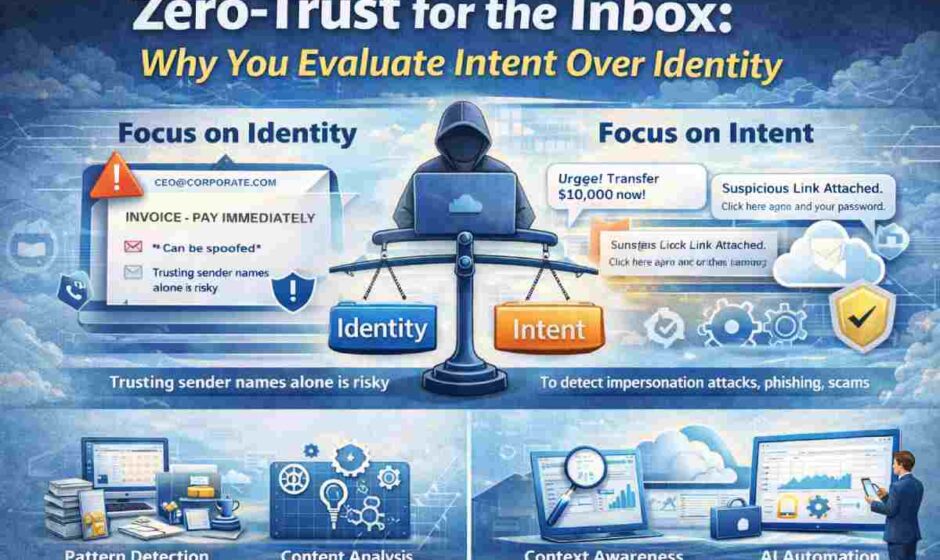

For years, email security has asked a simple question: Who sent this message? When the name has matched, when the domain has checked out, when the technical signals have aligned, the message has earned a place in your attention. That approach has worked to a point. Yet experience has revealed a limitation. Identity alone does not always reflect purpose. A message can look right and still carry the wrong intent. You now live in a moment where inbox security has grown more thoughtful. It asks a deeper question: Why has this message been sent?
Identity Serves as the Beginning
Email authentication standards such as SPF, DKIM, and DMARC still matter. They create a necessary foundation. They confirm that a message has come from where it claims. That is valuable. Yet it is not the full picture. A trusted account can be misused. A familiar sender can act outside their usual patterns. A vendor relationship can change in subtle ways. In these moments, identity remains intact, but intent tells a different story. You benefit when you treat identity as an introduction rather than a conclusion.
Intent Reveals Itself Through Patterns You Can Recognize
Intent appears through behavior, through rhythm, through consistency over time. Modern inbox protection reflects this truth, and you can see its value in practical terms. Systems observe how people usually communicate. They track timing, tone, structure, and frequency. Over time, a clear baseline forms. When a message steps outside that pattern, even in a small way, it draws attention. You might notice a request that arrives at an unusual hour. You might see a shift in tone that feels slightly off. You might receive a message that asks for something out of sequence. None of these signals alone confirms a problem, but together, they invite a closer look.
Trust Continues to Evolve After Delivery
In the past, a message entered your inbox and remained unchanged. Today, evaluation continues as new information becomes available. A message that appears safe at first can be reassessed later. New threat intelligence can emerge. User interactions can provide additional context. In response, the system can adjust. It may add a warning. It may limit access. In some cases, it may remove the message altogether. This ongoing process supports you without disruption. You do not need to monitor every detail on your own. The system works alongside you, reinforcing your decisions and adding a layer of thoughtful oversight.
You Reduce the Risk of Business Email Compromise
One of the most practical benefits of this approach appears in your ability to avoid business email compromise. These situations rarely rely on obvious deception. They succeed because they are reasonable. A known name, a familiar tone, a request that fits just enough to pass a quick review. When you focus on intent, you create a natural pause. You ask simple, grounded questions. Does this request align with past behavior? Does the timing make sense? Is the tone consistent with what you expect? These questions do not slow you down in a harmful way. They guide you toward clarity. A short confirmation, a quick follow-up, or a moment of reflection can prevent unnecessary complications. You protect resources, and you preserve trust within your professional relationships.
You Take a More Intentional Role in Your Inbox
Zero-trust for the inbox does not ask you to become suspicious of everything. It invites you to become attentive in a focused and constructive way. You remain confident in your tools, while also engaging your own judgment. Your inbox becomes more than a list of messages. It becomes a space where context matters. Each interaction carries patterns, expectations, and purpose. When you pay attention to these elements, your decisions become more consistent and more reliable.
A Clearer Way to Trust
As these systems continue to develop, you remain an essential part of the process. Technology provides structure and signals. You provide judgment and awareness, and together, they create a more resilient form of communication. This is the real value of zero-trust for the inbox. It offers not less trust, but better trust, built on attention, consistency, and a clear understanding of intent.